
Disproportionate anger, a compulsive need to please, or the constant sensation of not measuring up. On many occasions, psychology observes how individuals become trapped in repetitive and harmful emotional patterns, even while being fully aware of their irrationality. Why does this happen?
The answer lies within our deepest mental architecture: early maladaptive schemas.
Within the framework of modern psychotherapy, Schema Therapy has established itself as a highly effective approach. Developed in the 1990s by the American psychologist Jeffrey Young as an integrative expansion of Cognitive Behavioral Therapy, this discipline offers a map for understanding internal dynamics and relational patterns.
What Is a Schema and How Does It Originate?
A schema can be understood as a mental map or a filter through which reality is processed and interpreted. These structures are not innate; they are learned and consolidated during childhood and adolescence as an attempt to adapt to the environment and satisfy basic emotional needs (such as safety, affection, autonomy, or realistic limits).
When these developmental stages involve neglect, rejection, overprotection, or continuous criticism, maladaptive schemas are formed. These are implicit core beliefs about oneself and the environment: "I'm going to be abandoned," "I'm not good enough," or "I have to do everything perfectly to be accepted."
Activation: The Interplay Between Triggers and Vulnerability Factors
A fundamental aspect of Young's theory is that schemas are not filters that remain constantly active. An individual can function with complete normalcy and efficacy in their daily life until a specific situation or stimulus acts as a trigger.
However, whether an event activates a schema or not depends largely on the vulnerability state of the person at that moment. The exact same comment or everyday problem might have no impact during a period of stability, yet trigger an emotional collapse during a fragile phase.
Among the main vulnerability factors that amplify reactivity to a schema are:
Internal and physiological factors: Hormonal changes (such as stages of the menstrual cycle, postpartum, or perimenopause), sleep deprivation, physical exhaustion, or chronic pain.
Stressors and life stages: High work stress, grief, moving, major life transitions, or personal crises.
Recent events: Accumulated negative events in the short term (a prior conflict, bad news) that erode the margin of emotional tolerance.
Coping Styles: The Reaction
When the combination of a trigger and a vulnerability state exceeds the threshold of containment, the schema ignites and imposes its filter, setting in motion distinct coping styles:
Surrender: The schema is accepted as an absolute truth, and the person acts as a victim of the situation.
Avoidance: Physical or emotional withdrawal, isolation, or evasive behaviors are used to bypass the distress.
Overcompensation: The person reacts by attacking, fighting, or attempting to control the situation excessively to counteract the vulnerability generated by the schema.
Therapeutic Intervention: Identification and Self-Regulation
The primary goal of Schema Therapy is not to erase the past, but to develop an observational, adult posture.
Identifying the exact moment a schema activates and recognizing the vulnerability factors that facilitated that activation allows a pause to be introduced between stimulus and response. By understanding that an emotional reaction is the result of a schema's perceptual filter amplified by personal context, it becomes possible to soothe the emotional state and respond consciously, promoting healthier and more adaptive behaviors.
Reference Guide: Jeffrey Young's 18 Early Maladaptive Schemas
Jeffrey Young classified the 18 schemas into 5 major domains based on unmet emotional needs:
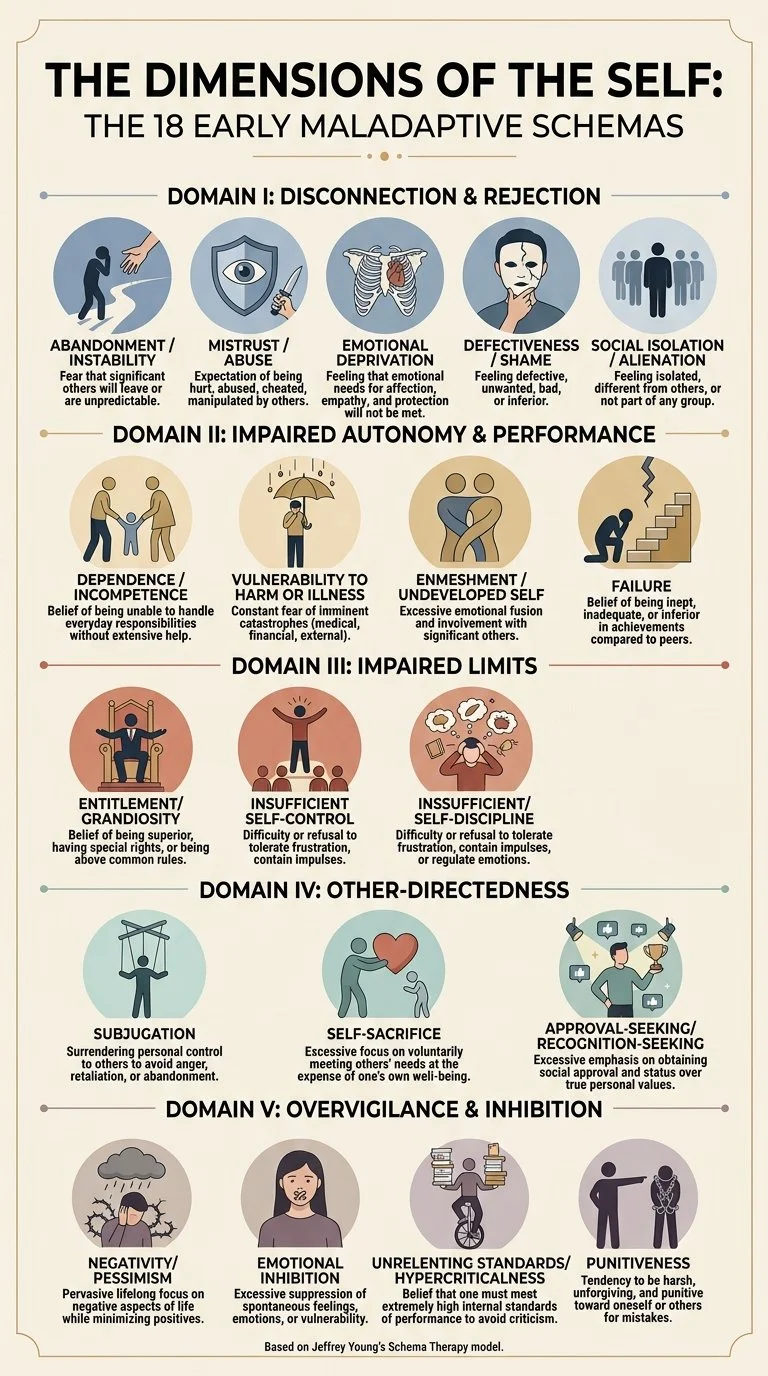
A Practical Case: When Past Stories Collide in the Present
(The names and identifiers in this example have been modified to preserve confidentiality).
To understand how these 18 schemas translate into everyday life, let's analyze the case of Mary and James.
Mary grew up in a family where affection was conditional on school grades and impeccable order. She learned very early that to feel safe and loved, she had to be perfect and control every detail. This consolidated her Unrelenting Standards / Hypercriticalness schema.
James, on the other hand, had a childhood marked by a highly critical father who constantly compared him to his siblings and made him feel that his achievements were never enough. He grew up convinced that whatever he did, he was bound to fail, developing a clear Failure schema.
Years later, Mary and James marry. They love each other deeply, but their learned schemas act as invisible time bombs.
The Scene: A Friday evening, after an exhausting week of work and with little accumulated sleep (a clear vulnerability factor), Mary arrives home and discovers that James has forgotten to buy an important item for the weekend.
1. The trigger in Mary: Her fatigue reduces her tolerance threshold and activates her unrelenting standards schema. Her mind interprets the oversight as unacceptable chaos. Without realizing it, she activates an overcompensation mode and attacks James harshly: "This is unbelievable! You never pay attention to anything, you act like you don't care about the house at all."
2. The trigger in James: Those words do not land on James as a simple, punctual critique about groceries; instead, they pass directly through the filter of his Failure schema. In his mind, his childhood voice echoes: "See? You never do anything right, you're useless."
3. The Spiral: Overwhelmed by shame and pain, James reacts by activating an avoidance and defensemode: he locks himself in his study, slams the door, and refuses to speak. To Mary, James's withdrawal is seen as yet another lack of responsibility, further fueling her indignation.
The problem wasn't the grocery item itself. In that argument, it wasn't just adult Mary and adult James talking; the inner child wounds of both were clashing.
Understanding the architecture of these schemas and recognizing our moments of vulnerability is the first step to dismantling automatic dynamics and building more balanced, satisfying emotional responses.